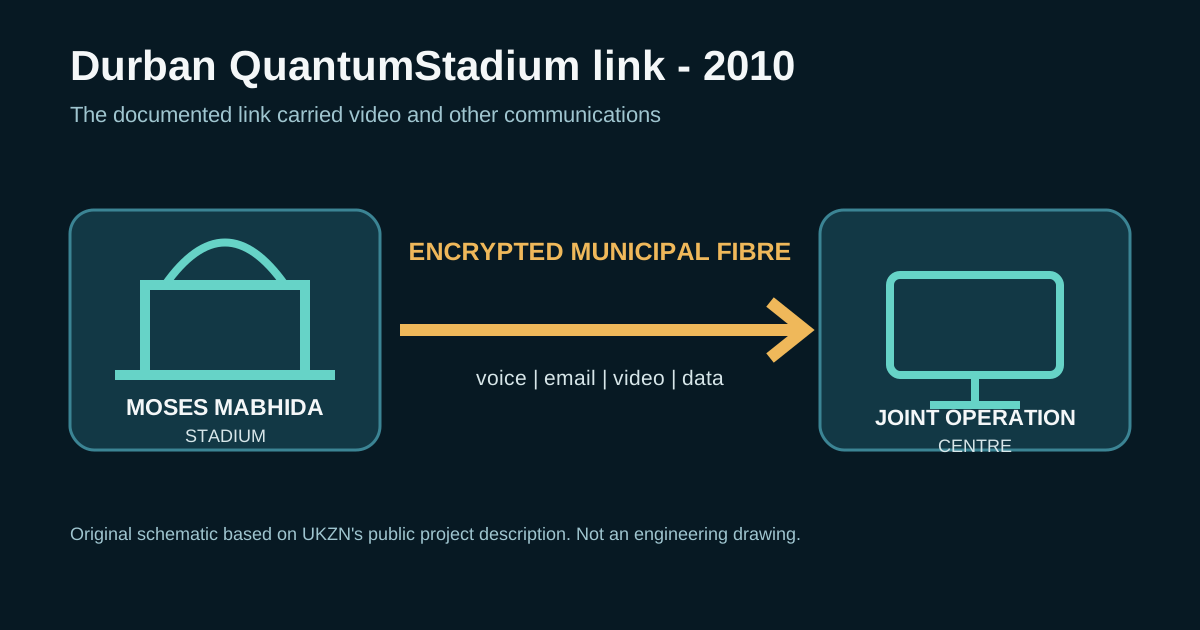
During the 2010 FIFA World Cup period, a high-security fibre link connected Moses Mabhida Stadium with Durban’s Joint Operation Centre.
The University of KwaZulu-Natal’s Centre for Quantum Technology describes the QuantumStadium project as a hybrid encryption system using quantum key distribution alongside conventional encryption. The link carried telephone, internet, video, data and email traffic at up to one gigabit per second.
It was installed in April 2010 and publicly launched in May. UKZN presented it as the first use of a quantum-based encryption solution at a public global event.
This was network security, not a magic camera
The phrase “quantum security” can invite exaggeration. The project did not turn an ordinary camera into a quantum device. It protected communication between two locations by using quantum methods in the key-distribution process for an encrypted link.
The camera or video system remained one source of data travelling across that network. The distinction matters because CCTV security has several layers:
- the camera hardware and firmware;
- device credentials;
- the local network;
- transmission between sites;
- recorder or video-platform access;
- user permissions;
- exported evidence; and
- backups.
Protecting one link does not automatically secure every layer.
Why Durban’s fibre backbone mattered
The QuantumStadium project grew from the earlier QuantumCity initiative, which UKZN showcased in 2008 on eThekwini’s municipal fibre infrastructure. Fibre provided the capacity to move high-bandwidth city data, including video, between important facilities.
Modern commercial CCTV across Durban and KZN follows the same underlying principle at a smaller scale. When cameras span buildings, warehouses, gates or distant parts of an estate, the network becomes part of the security system.
Designers have to answer:
- How much camera traffic will cross each link?
- Is there capacity during peak use?
- What happens when a switch or fibre path fails?
- Are camera networks separated from ordinary user devices?
- Who can administer the system remotely?
- Are firmware, passwords and certificates maintained?
Resolution and lens choice still matter, but they are not enough once video leaves the camera.
The Joint Operation Centre idea
Major events require different teams to build a shared operating picture. Video, communications and other data have to arrive at a place where authorised people can interpret them and coordinate a response.
That is why the link between Moses Mabhida Stadium and the Joint Operation Centre is an important Durban CCTV-adjacent milestone. It shows video as one part of a wider communications environment rather than an isolated monitor feed.
For a KZN business, the equivalent may be a security office that receives camera events, access-control information and calls from staff. The scale differs; the integration problem is recognisable.
A careful historical conclusion
It would be inaccurate to say that “Durban’s CCTV ran on quantum encryption” in 2010. UKZN’s source supports a narrower and more interesting claim: a crucial municipal event link carrying video and other traffic was secured by the QuantumStadium solution.
That precise version demonstrates genuine local technical history without turning it into marketing mythology.
Research note
The project description, dates and architecture come from the UKZN Centre for Quantum Technology’s QuantumCity and QuantumStadium page. Technical wording has been simplified, and the article explicitly limits the conclusion to the documented link.