In 2014/15, eThekwini faced a familiar upgrade question on a very large scale: replace an ageing analogue CCTV estate at once, or migrate in stages.
A trade-publication report described 263 municipal cameras and limited coverage outside key central areas. Nine durable analogue cameras on Durban’s beachfront were adapted to work with planned IP additions, while 60 analogue CBD cameras were to remain until budget allowed their replacement or upgrade. New IP and thermal cameras were being introduced in KwaMashu and Newlands.
The decision was not a declaration that old equipment was as capable as new. It was a practical interoperability strategy.
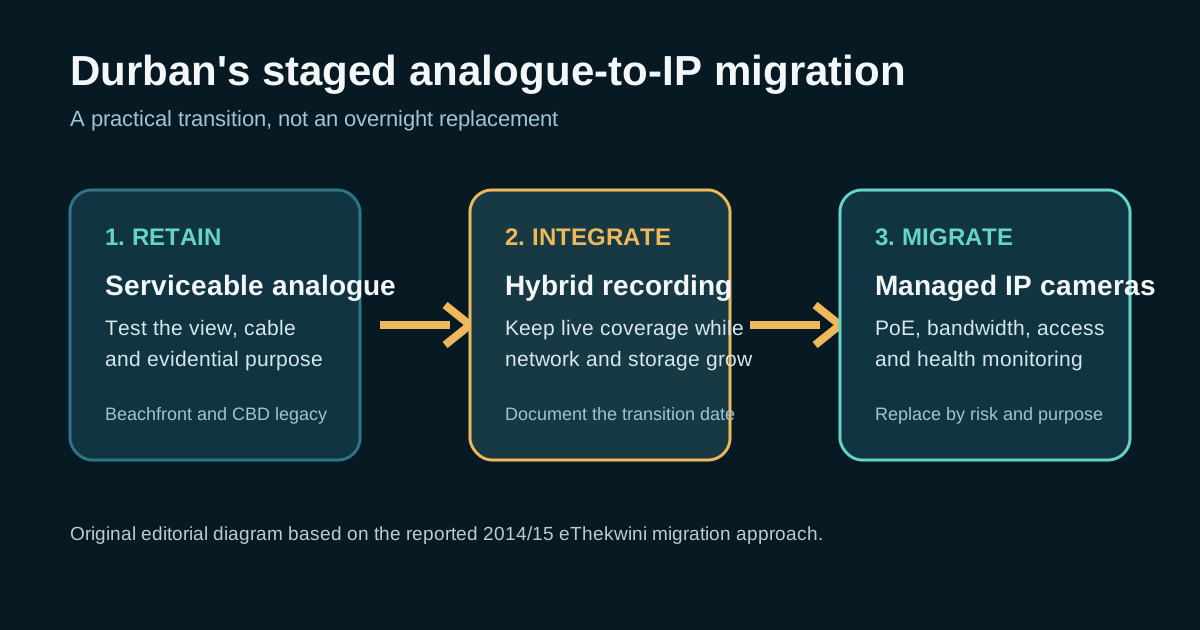
Why a complete replacement can be difficult
Large CCTV systems accumulate cameras, cable routes, control-room equipment, user habits and maintenance dependencies. Replacing every component simultaneously can create cost and operational risk.
A staged Durban or KZN upgrade may be sensible when:
- existing coaxial cable is sound;
- retained cameras still answer a low-risk overview purpose;
- a hybrid recorder can support old and new channels;
- critical views can move to IP first;
- the network and storage platform need time to expand; and
- the transition can preserve access to old evidence.
Retaining equipment only makes sense after testing it. “It still shows a picture” is not enough if the view no longer delivers the required detail.
Why IP cameras were attractive
The eThekwini official quoted by the publication highlighted scalability and installation or maintenance benefits. The planned system also introduced video analytics and thermal views in very low-light areas.
IP architecture can support higher-resolution streams, flexible networking, remote health monitoring and analytics. It also creates new responsibilities: switch capacity, PoE budgets, bandwidth, addressing, credentials, firmware and cybersecurity.
The migration is therefore from one kind of system engineering to another—not from engineering to simplicity.
Mixed systems need a written endpoint
Temporary hybrid arrangements often become permanent by accident. A good migration plan should state:
- which cameras remain and why;
- which views are priority replacements;
- how recording and playback work during transition;
- whether timestamps and camera names stay consistent;
- when legacy components become unsupported; and
- what event triggers the next phase.
Without that plan, each later repair becomes a separate emergency decision.
Research note
The historical architecture is reported in “Securing inner city areas,” SMART Security Solutions, February 2015. It is a trade source quoting eThekwini’s disaster-management leadership, so feature benefits remain attributed rather than presented as an independent product test. The accompanying diagram is an original editorial graphic based on the reported migration structure; it does not reproduce a municipal network drawing.