In August 2003, Durban’s open-street CCTV network offered a blunt demonstration of the difference between owning cameras and operating a surveillance system.
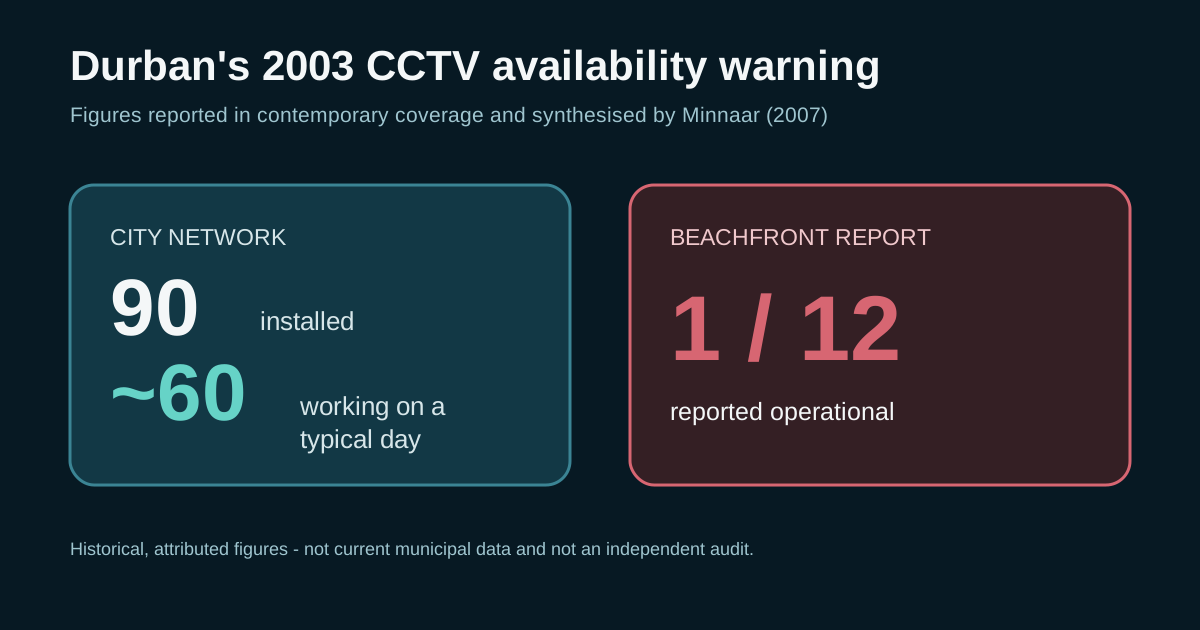
A 2007 academic review of contemporary reporting records that about 60 of 90 installed cameras were working on a typical day. The beachfront position was reported as worse, with one in twelve operational. The same account describes one operator handling more than ten cameras and says footage was not being recorded.
These figures are a dated historical snapshot, not current municipal statistics. Their value lies in the failure pattern.
Four failures compounded one another
The 2003 account was not about a single broken camera. It described problems at four layers:
- Availability: many endpoints were not working.
- Coverage: failures created gaps in the areas the network was meant to observe.
- Monitoring: too few people were available for the number of views.
- Recording: footage was not being preserved for later use.
Solving only one layer would not have restored the system. Repairing cameras without recording would still leave no evidence archive. Restoring recording without operator or response capacity would improve investigation but not live intervention. Adding staff without reliable pictures would overload people with unusable feeds.
The maintenance debt behind a camera fault
A camera can fail visibly by going offline, but many faults are quieter:
- a dirty or salt-marked cover softens the image;
- water reaches a junction or connector;
- vegetation blocks the intended view;
- infrared light reflects from a wall or soffit;
- the recorder’s clock drifts;
- a hard drive reports healthy but does not retain the promised number of days;
- a password or app account is lost when a staff member leaves;
- a PoE switch has no spare power or port capacity.
Durban’s coastal environment makes inspection especially important. Heat, humidity, wind-driven rain, salt air, insects, lightning and vegetation can turn a tidy installation into an unreliable one if housings, cable entries, surge protection and cleaning access were not planned.
Proof-of-performance is better than a green status icon
A practical maintenance visit should test the result from the user’s perspective:
- Open every named camera.
- Check its intended subject in daylight and darkness.
- Search and replay a known time.
- Export a short clip and verify it on another device.
- Confirm the timestamp and camera name.
- Test remote access for the authorised user.
- Record faults, fixes and deferred risks.
This is how a Durban business can distinguish “camera online” from “system ready.”
The long-term lesson
The academic review says Durban responded with specialist investigation and further upgrade funding. The larger digital rebuild followed in 2005.
The important historical point is not that an early system struggled. Early city networks around the world encountered technical and organisational problems. The important point is that camera performance depended on recurring operational expenditure, trained people and evidence workflows.
Those requirements did not disappear when CCTV moved from analogue to IP. They became easier to measure—and easier to neglect at larger scale.
Research note
The historical facts are drawn from Anthony Minnaar’s 2007 Durban case study, which attributes the 2003 figures to contemporary reporting. Because the original report requires further archival acquisition, the article preserves that attribution and avoids presenting the figures as independently audited facts.