Durban’s Eye-in-the-Sky story did not begin with a single citywide CCTV system. It began in 1995 with two purposes and two groups of cameras: traffic management in the central business district and tourist protection along the beachfront.
Over the following decade the network expanded, struggled, was rebuilt and changed institutional owner. That makes it more useful than a triumphal list of camera numbers. It shows the full lifecycle of urban CCTV: purpose, pilot, expansion, operational debt, modernisation and governance.
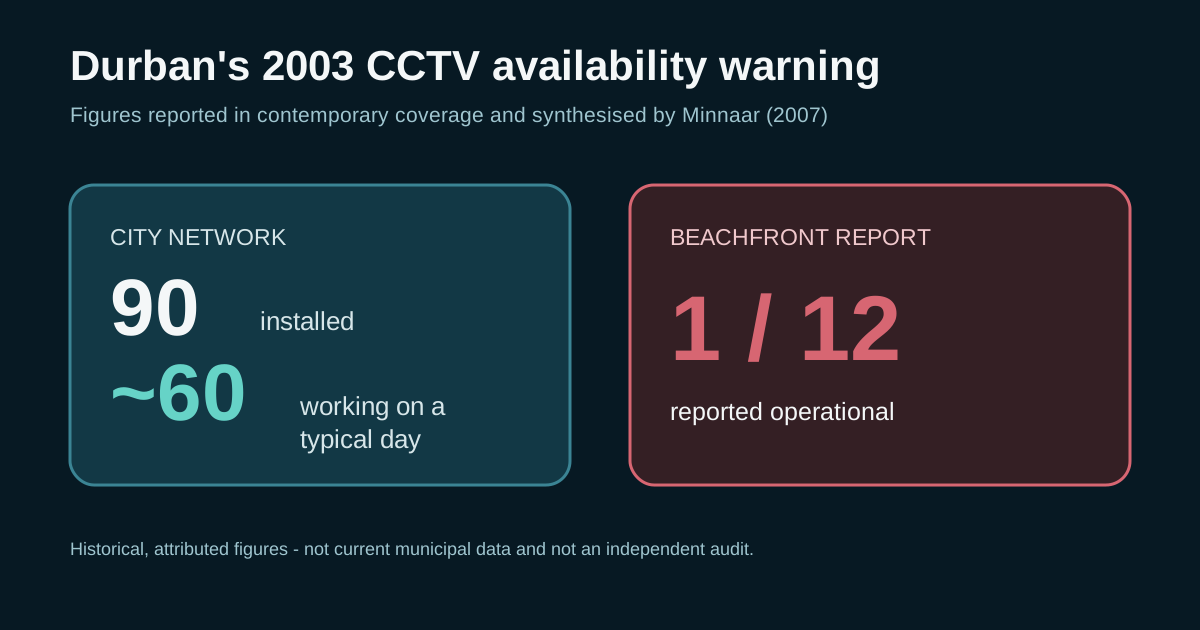
Historical reported figures, not current municipal data or an independent technical audit.
1995: traffic and tourist protection
According to Anthony Minnaar’s later academic reconstruction of contemporary records, Durban City Council announced plans in July 1995 for 40 traffic-flow cameras in the CBD and 12 cameras along the beachfront for tourist protection and crime control.
Those are related but different jobs. A traffic camera needs to show congestion, incidents and movement across a road. A crime-prevention camera may need usable detail at pedestrian routes, public spaces and intervention points. Reusing one view for another purpose can work, but only if the image, operator and response process fit the second task.
The planned crime component was delayed during local-government restructuring. That early delay is an important part of the history. Cameras depend on an organisation that owns procurement, staffing, control-room procedure and response. Reorganising that organisation can delay the technology even when the equipment is understood.
1998: a 15-camera beachfront pilot
The Eye-in-the-Sky pilot was commissioned in 1998 with 15 beachfront cameras. The reported partnership involved Durban Metro Police, the South African Police Service, Business Against Crime KwaZulu-Natal and the council.
A pilot is more than a small purchase. It should test where cameras add value, how operators communicate with responders, whether views remain usable at night, what gets recorded and how incidents are logged. Durban’s pilot was rooted in a real geographic purpose: a busy public beachfront central to the city’s tourism identity.
The network then expanded beyond the pilot. Minnaar records 23 cameras in central Durban and a further 15 around the International Convention Centre. The system was no longer one line of beachfront views; it was becoming a multi-area urban operation.
By 2000: 67 cameras, but not 67 watched views
The academic review and contemporary reporting record 67 cameras in central Durban by the end of 2000. IOL described cameras originally used for traffic being used in the crime-prevention effort.
The camera count sounds like the achievement. The operator count reveals the constraint. Minnaar’s account says insufficient staffing meant not every camera received live monitoring.
That distinction remains central to CCTV design. A recorder can store many channels. A person cannot meaningfully watch unlimited screens. If the operating model depends on live intervention, staffing, event prioritisation and radio communication are system components. If staffing cannot scale, analytics and post-event search may help—but neither replaces a clearly funded response model.
The Safer City approach was wider than cameras
In November 2000, contemporary reporting described a R2.5 million allocation for upgrading the camera system, monitoring and operator training, with a further R7.5 million reported for the following two years.
The Safer City programme combined law enforcement with targeted social prevention and environmental design. That context matters because CCTV is most often useful as part of a system: lighting, sightlines, place management, dispatch and physical response. A camera observes conditions; it does not repair the environment or perform the intervention.
Operator training in the budget is equally telling. The person behind the screen has to understand the geography, recognise an event, control the camera, record the right information and direct the right responder. Training is not overhead added after installation. It is part of the system’s intended capability.
2003: the difference between installed and operational
The most sobering point in the timeline arrived in 2003. Minnaar’s synthesis of contemporary reporting describes 90 cameras installed, with about 60 working on a typical day. Reported beachfront availability was especially poor; operator load was high and footage was not being recorded as required.
These were dated reported conditions, not a permanent verdict on Durban’s system. They illustrate three separate availability measures:
- installed: hardware exists at the site;
- online: an image reaches the system; and
- operationally useful: the view is usable, recorded and connected to a response process.
Public discussions often collapse those into one number. They are not equivalent. A blurry, unrecorded camera can be online and still fail its evidential purpose.
2005: digital rebuilding and overlapping coverage
Early in 2005, Durban introduced 40 digital beachfront cameras with reported 24-hour coverage, recording backups and a process in which a neighbouring camera could take over when another view degraded.
That handoff idea is a mature design principle. Cameras should not be treated as isolated dots. Overlap can preserve route continuity when a view is blocked, under repair or aimed elsewhere. It cannot replace every identification angle, but it turns one failed unit from a total blind spot into a managed reduction.
The move to digital equipment also changed recording, transmission and control. Digital does not automatically mean reliable; it gives engineers better tools to centralise, search and monitor health when those functions are configured and maintained.
August 2005: a larger control room
The August 2005 upgrade reportedly connected 150 digital cameras. The academic account says staffing rose from two people to a minimum of 16 per shift. Coverage included areas near the M25/N2 by Gateway and Suncoast, showing the network moving beyond the original beachfront/CBD core.
The important change was not only more cameras. Camera estate, control-room capacity and operational geography grew together. A system that expands its edge without expanding its centre simply concentrates more unattended video in one room.
2006: CCTV becomes city infrastructure
At the beginning of 2006, operational control moved from Metro Police to Emergency Services. Plans referred to a network of 220 cameras, recorded material being used for crime mapping and hotspot analysis, and operator links to both Metro Police and SAPS radio.
The surveillance-centre manager cited in the historical review also described uses beyond crime: noticing water faults, failed traffic lights, electrical problems, crashes and fires. By then, the camera network was becoming a form of city observation infrastructure.
That wider purpose makes ownership more complicated. Traffic, policing, emergency response and municipal engineering may all use the view. Someone still has to own maintenance, evidence access, privacy, recording and budget.
What Durban’s first decade teaches
The Eye-in-the-Sky period produced five lessons that still apply to a Durban home, body corporate or business:
- Define the purpose before choosing the view.
- Count operational coverage, not boxes installed.
- Size people, recording and response with the cameras.
- Budget for maintenance and replacement every year.
- Make one party accountable for the complete result.
Durban’s history is not a straight march from 15 cameras to hundreds. It is a cycle of learning what the entire system requires. The camera is the visible part; operations determine whether it becomes evidence.