Durban’s municipal CCTV history is often reduced to cameras on streets and the beachfront. eThekwini’s 2019/20 project tables show a broader estate: CCTV project lines also appeared under parks, recreation, cemeteries and culture; income-related facilities; real estate; and Metro Police.
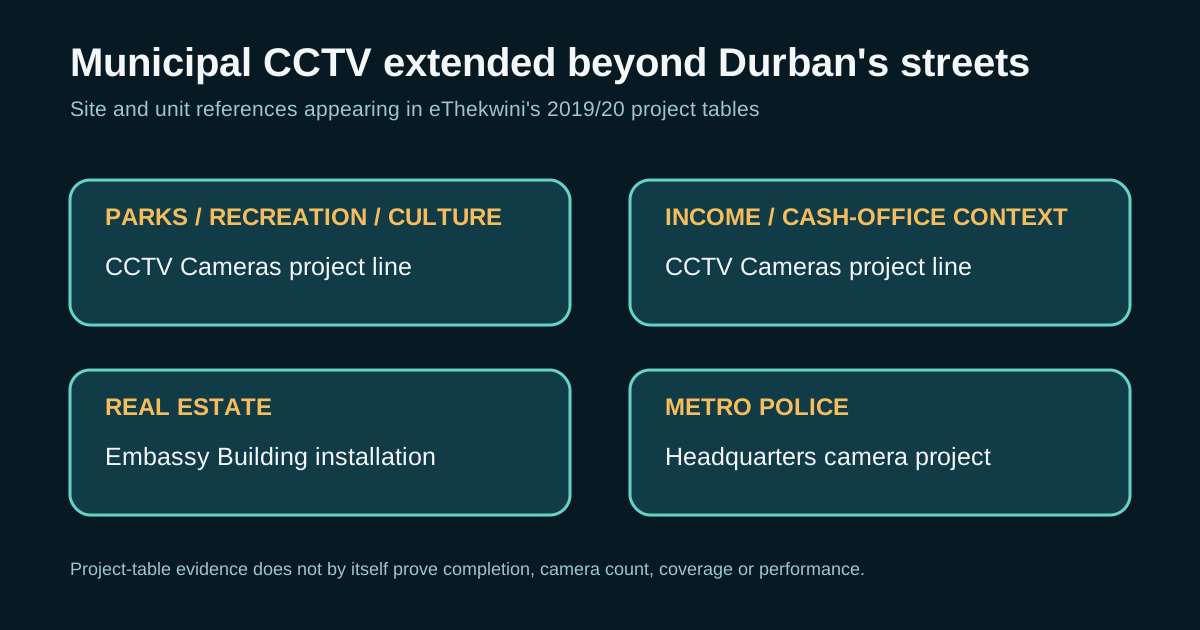
The report includes references to CCTV cameras in the Parks, Recreation, Cemeteries and Culture unit, an Income-unit project, an installation at the Embassy Building under Real Estate, and cameras at Metro Police headquarters.
These are project-table entries. They do not establish camera counts, exact coverage, completion quality or current operating status. Their value is showing the range of municipal environments being considered or funded.
Different buildings create different CCTV purposes
A cultural facility, cash office, administrative property and police headquarters should not receive identical camera designs merely because they belong to one organisation.
Possible purposes differ. A public cultural facility may prioritise entrances and protection of property. A cash-handling environment may require transaction context and tightly governed evidence access. A municipal office may focus on reception and after-hours intrusion. A police facility may have vehicle, evidence or staff-safety requirements that demand stricter governance.
The report does not confirm which purpose applied to each line. Those are questions a site survey and operational brief should answer.
Why one municipal platform becomes difficult
When cameras expand across unrelated departments, technical variation grows. Buildings may have different networks, opening hours, power systems, recorders, manufacturers and support contracts.
Without common standards, an organisation can end up with incompatible viewing applications, inconsistent retention and permissions, cameras whose clocks disagree, duplicated administrator accounts, no common fault reporting and uncertain responsibility when footage is requested.
This helps explain why the same 2019/20 report discussed integrating cameras into a private video cloud and converting analogue equipment to IP at 50 sites. The building projects and platform project were connected management problems even if each site retained its own purpose.
Project approval is not operational proof
A budget or project table can show intention, allocation or recorded status. It cannot prove that every camera was installed correctly, handed over with documentation or maintained afterward.
For credible historical writing, the stages stay separate: a need is identified; funding and procurement are recorded; installation and commissioning occur; users receive access and training; faults are managed; and the system continues—or fails—to meet its purpose.
This distinction also protects current Durban businesses from a common procurement mistake: treating the equipment invoice as the end of the CCTV project.
The local lesson for multi-site organisations
Schools, retail groups, warehouses, body corporates and business parks across KZN face a smaller version of the municipal problem. Different sites accumulate different recorders and standards over time.
A useful multi-site plan begins with a register: site, camera purpose, owner, network, recorder, retention, authorised users, maintenance responsibility and backup-power behaviour. Central viewing should be added only after access and privacy boundaries are defined.
The eThekwini project lines therefore broaden Durban’s historical CCTV geography. The network was not only about watching public roads. It extended into the varied buildings and departments through which a municipality actually operates.
Research note
The claims come from the project and capital-table entries in the eThekwini 2019/20 draft annual report. The document is a draft report, so every line is presented as recorded project evidence rather than proof of present-day system status.