Long before Durban’s beachfront and CBD cameras were watched from control rooms, the city’s security work depended on people stationed at factories, offices, gates and other properties.
Archived Ilanga pages from 1980 to 1990 document that human layer through recruitment adverts, an isiZulu report about guard grades and rights, and a growing market for commercial security courses.
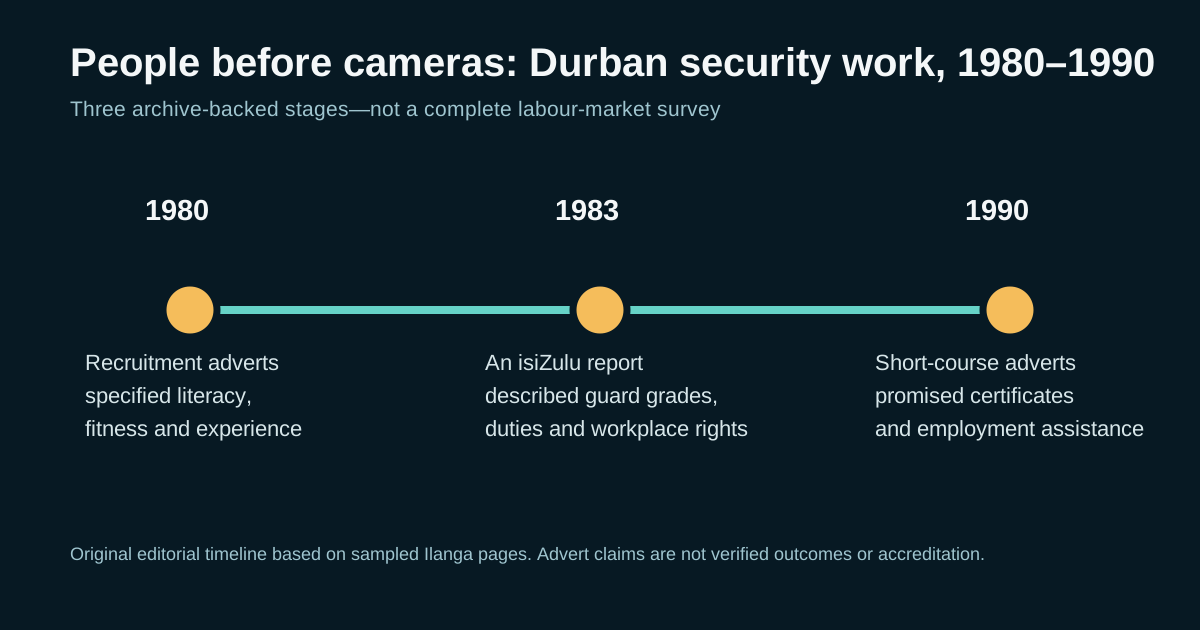
This material is adjacent to CCTV history rather than proof of early camera systems. It matters because cameras have never removed the need for judgement and response. Technology changes what a person can see; it does not decide automatically what the observation means or what should happen next.
What Durban employers asked for in 1980
A Maydon Wharf recruitment advert published in December 1980 sought security guards who were fit and healthy, aged 30 to 35, able to speak, read and write English and preferably experienced in security work. It said successful applicants would attend training, work eight-hour shifts and receive specified benefits and a starting wage.
Another page that month carried Durban-area adverts asking for security or police experience and English literacy.
These are employer statements, not an independent account of real working conditions. They nevertheless show that guarding was being described as a job with selection criteria, training and shift responsibilities—not merely an unidentified person placed at a doorway.
Umlazi recruitment emphasised responsibility
In June 1983, a vacancy at the KwaZulu Development Corporation’s Umlazi head office asked for reliability, a school certificate and three years of security experience, including possible experience in the police, defence force, prison service or related organisations.
The advert also promoted salary, fringe benefits, an annual bonus, study opportunities and a pension scheme. Again, the source proves what the employer offered in print, not what every employee received.
The operational idea is still familiar. A security role depends on trust, observation, accurate reporting and following a response procedure. Those requirements later carried into CCTV control rooms.
A 1983 article described grades, duties and rights
The strongest record in this group is not an advert. On 8–10 December 1983, Ilanga published a substantial isiZulu article arguing that guards should understand their rights.
The article discussed uniforms, hours, overtime and freedom of association. It also described three categories: nightwatchmen, Security Guard Grade 2 and Security Guard Grade 1. Its description of Grade 2 included searching vehicles, people and goods entering or leaving a factory, while Grade 1 involved supervision.
That is valuable Durban security history because it records the work behind site protection: checking movement, enforcing procedures and supervising other personnel. A full published translation should still be reviewed by a fluent isiZulu editor; this draft uses only the clearly supported structure and themes.
By 1990, security training was a visible market
The 1990 pages show numerous central-Durban businesses advertising guard and security courses. Advertised durations ranged from about ten days or two weeks to longer correspondence programmes. Some sellers promised certificates, employment assistance or progression towards security management.
Those claims must be handled cautiously. A newspaper advert does not establish accreditation, teaching quality or whether a learner found employment. What it does establish is a visible commercial market built around entering and progressing within security work.
The connection to modern Durban CCTV
Today’s technology can place many camera views, alarms and access events in front of one operator. That makes role definition more important, not less.
A useful CCTV operating procedure should define:
- which events need immediate attention;
- what an operator must verify before escalating;
- who receives a call or radio message;
- how descriptions and timestamps are recorded;
- when footage must be preserved; and
- what happens when a camera, network link or recorder fails.
An impressive video wall cannot compensate for unclear duties. Equally, a trained guard cannot act on a camera view that is obscured, badly lit or unavailable.
The archive therefore adds a human beginning to Durban’s CCTV story. Before large camera estates, there were already workers being recruited, graded, trained and asked to control movement through local sites. Modern CCTV extended their visibility; it did not replace the need for people and procedures.
Research note
The dates and page links are recorded in the security-guard workforce sample. The newspaper scans are not cleared for commercial reuse, so this article uses an original timeline rather than reproducing the pages or their photographs.