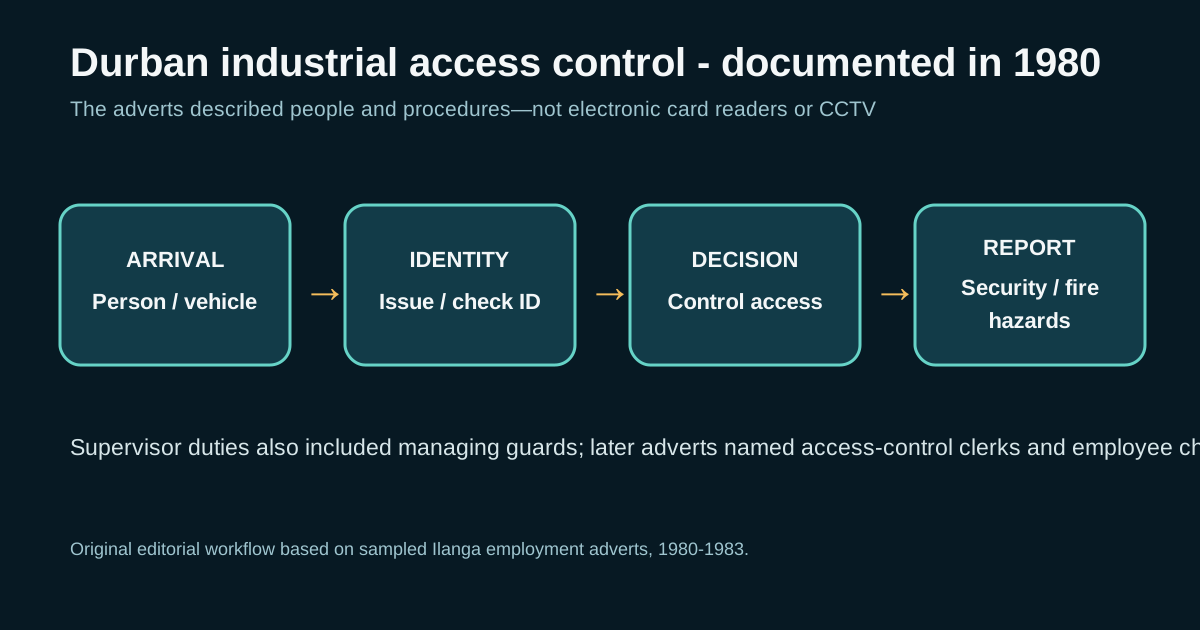
Durban employment adverts from November 1980 used “access control” as a defined industrial-security responsibility. The role was described in human and procedural terms: supervising guards, issuing identity cards, controlling entry and identifying security or fire hazards.
There is no evidence in these adverts of electronic card readers, databases or security cameras. That is precisely why they are useful. They document the operating problem before today’s technology became the familiar answer.
Access control began with a decision
At its simplest, access control asks whether a person or vehicle should be allowed through a boundary. In the 1980 adverts, that decision depended on guards, a supervisor and an identity-card process.
The repeated vacancy wording assigned the supervisor responsibility for supervising security guards, access control, issuing ID cards and identifying security or fire hazards. Because substantially similar wording appeared several times, it may represent one vacancy advertised repeatedly. It should not be counted as several independent Durban installations or employers.
Mobeni had a named access-control position in 1981
In February 1981, Nampak Products in Mobeni advertised for an “Access Control Clerk” within its security team. The position was described as responsible work and carried education and age requirements.
The title shows that access activity could be specialised rather than only one incidental duty assigned to a general guard. It also places the terminology in a recognisable Durban industrial area.
A 1983 mill-security advert extended the picture. It included employee access control, general patrols and the identification of fire and safety hazards among guard duties.
These sources do not establish how entries were logged, what the ID cards looked like, whether visitors were escorted or how consistently rules were applied. The safe conclusion is narrower: access control was an explicit part of Durban-area industrial security by 1980.
What electronic systems changed
Modern access control can automate the credential check and create a timestamped record. A card, tag, PIN, mobile credential, fingerprint or other approved identifier can be assigned to a person and limited by door, area or schedule.
Yet electronic equipment does not eliminate the old decisions. Someone must still determine who qualifies for access, which areas and times are authorised, how visitors are handled, what happens when credentials are lost, who investigates a forced door and how access continues during power or network failure.
Those are governance and response questions, not reader specifications.
Where CCTV fits—and where it does not
Access control records the credential or decision presented to the system. CCTV can add visual context: whether the cardholder was the person who entered, whether someone followed through the door, or what happened around a rejected attempt.
The systems should not be confused. A camera does not revoke a lost card. A valid credential does not prove that only one person crossed the threshold. Integration is useful when clocks agree, the relevant view is correctly positioned and authorised staff can retrieve both records without bypassing privacy controls.
For Durban factories, warehouses and offices, local conditions add practical requirements: protected cable routes, reliable power, weather-resistant gate equipment, lightning protection and a manual fallback that does not leave the site uncontrolled.
A precursor with a direct modern lesson
The 1980 adverts reveal the enduring structure of access control: identity, authority, boundary, decision and response. Today’s systems are faster and more searchable, but they still rely on those definitions.
That makes this a legitimate precursor in Durban’s CCTV history. It does not pretend cameras were present. It shows the established industrial workflow that later cameras, intercoms and electronic credentials could support.
Research note
The industrial access-control sample records all five page links and the safe editorial boundaries. The Ilanga scans are copyright-restricted, so the article uses an original workflow rather than reproducing the advertisements.