By 1990, security was not hidden in the technical small print of Durban-area property advertising. It was appearing alongside bedrooms, carpeting, garages, gardens and fencing—the ordinary features used to sell a home.
We hand-checked twelve Ilanga property pages published between March and December 1990. Every sampled page contained “burglar guard” or a grammatical variant. Three contained “burglar alarm”, six used the phrase “security system” somewhere on the page, and two contained “security gate”.
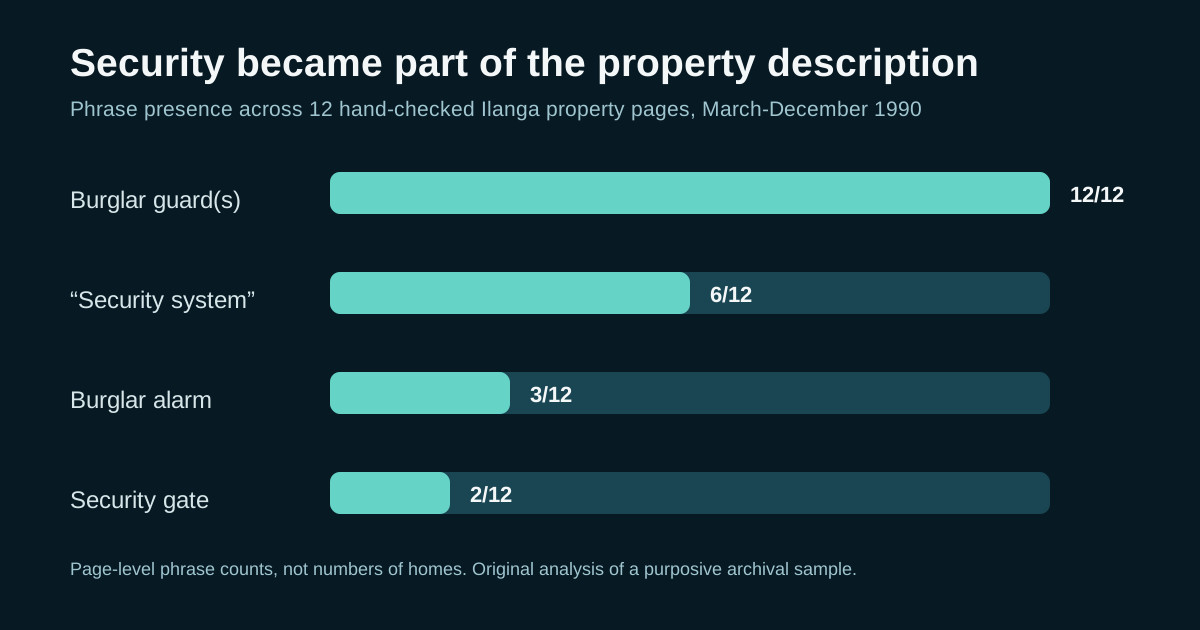
These are page-level findings, not household statistics. A classified page may contain many adverts, and a phrase’s presence does not prove that every advertised device worked. The pattern still tells us something original: physical and electronic security had become marketable language across greater Durban before home CCTV was an everyday purchase.
The geography was broader than central Durban
The sampled pages contain property advertising for places including Umlazi, KwaMashu, KwaDabeka, KwaNdengezi, Klaarwater and Isipingo. The adverts mix security terms with proximity to schools and transport, quiet-area claims, fitted kitchens, concrete fences and drive-in access.
Klaarwater provides a particularly clear recurring example. Later-1990 adverts repeatedly describe a home using burglar guards, a “security system”, grass and full fencing as a combined package. Repeated wording may represent the same property being marketed more than once, so it would be wrong to count each appearance as a separate installation. Repetition is nevertheless evidence that the seller considered the security description worth retaining.
From burglar guards to layered systems
The adverts show several security layers occupying different roles:
- burglar guards physically reinforce openings;
- a security gate controls or delays entry;
- an alarm detects a protected event;
- a fence defines and delays access to the property; and
- CCTV, where present, can observe and record selected areas.
That logic remains recognisable in Durban home-security planning today. The equipment has changed dramatically, but the mistake of expecting one layer to do every job has not.
A camera placed at a driveway may help identify vehicles but offer little detail at a side window. Burglar guards can delay entry but do not notify an owner. An alarm can raise an event but may not explain it. Good design assigns a purpose to each layer and defines what the household or response provider should do next.
Two adverts cross directly into residential CCTV
Two Isipingo Hills adverts go beyond precursor language. The first, dated 2–4 April, describes a four-bedroom executive home with an alarm and “close circuit TV terminals”. In May, a different six-bedroom home was advertised as burglar-guarded, fenced and fitted with “closed circuit T.V.”; that second advert was repeated in a later issue.
The adverts supply no camera count, CCTV brand, recording method or proof of condition. We therefore treat them as documented listings, not verified technical surveys. They are covered in a separate article because their claim is materially different from the broader advertising pattern.
What the archive can safely tell us
The twelve-page sample supports a cultural and commercial conclusion: security features had become normal enough to help describe and differentiate Durban-area homes.
It cannot calculate adoption rates, compare suburb risk, show whether security added to sale prices or prove that the advertised measures prevented crime. Those would require different evidence.
This boundary makes the history more credible. The value lies not in stretching a classified advert into a citywide claim, but in assembling repeated, dated primary records that reveal how Durban residents were being spoken to about home security.
Research note
The complete twelve-page evidence sample records the dates, page links, search method and editorial limits. The newspaper scans are copyright-restricted, so this article uses an original data graphic rather than reproducing the adverts.