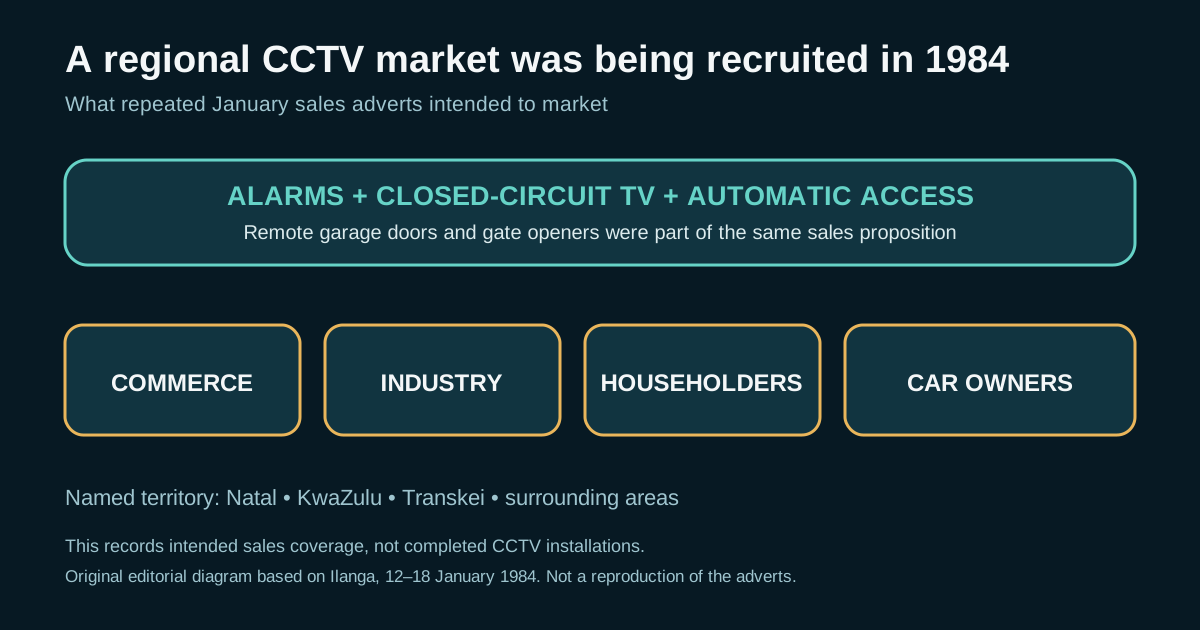
In January 1984, a repeated Ilanga recruitment advert sought salespeople to market electronic burglar alarms, closed-circuit television and automatic access products across Natal and KwaZulu. The intended customers included householders as well as commerce and industry.
That combination makes the campaign an important link in Durban and KZN’s CCTV history. It shows that closed-circuit TV was no longer confined to a specialist training or broadcast context. A security supplier expected sales staff to explain and sell it as part of a wider electronic-protection package.
The same basic campaign appeared in issues dated 12–14 January and 16–18 January. Repetition helps confirm the wording, but it does not represent two companies or prove two batches of installations.
What the recruitment advert offered
The product list joined four related technologies:
- electronic burglar alarms;
- closed-circuit TVs;
- automatic remote garage doors; and
- gate openers.
The advert also named commerce, industry, householders and car owners as prospective markets. Geographically, it called for salespeople across Natal, KwaZulu, Transkei and surrounding areas.
This was a broad sales proposition. CCTV sat beside detection and automated access, rather than being advertised as a stand-alone object. That is recognisably similar to today’s layered approach, where cameras, alarms and controlled entrances perform different jobs.
Evidence of a market—not proof of installations
A recruitment advert can show what a supplier hoped to sell, to whom and where. It cannot establish that CCTV was installed at every type of property named, or anywhere in the advertised territory.
It also gives no camera specifications, prices, brands, recording equipment or maintenance arrangements. “Closed circuit TVs” may describe complete systems in commercial language, but the page does not define their components. We therefore use the source as evidence of market intent and vocabulary, not installed-system coverage.
That distinction is especially important for local historical SEO. A precise statement—that CCTV was actively marketed to homes and businesses in Natal and KwaZulu in January 1984—is stronger than an unsupported claim that it was already common.
Why the customer mix matters
The inclusion of householders is notable. Durban’s archive contains direct residential CCTV property adverts from Isipingo Hills in 1990, six years later. The 1984 recruitment campaign does not prove those later systems came from the same supplier, but it establishes that homes were already an intended CCTV market.
Commerce and industry were also natural prospects. Sites with stock, cash handling, controlled entrances or after-hours risks could combine observation with alarm detection and automatic gates. For industrial premises, access rules and guard procedures were already established parts of security work in Durban by 1980.
The campaign therefore sits at a transition point: human guarding, ID checks and burglar protection remained central, while electronic observation and remote access were being sold into the same security landscape.
A regional, not merely central-Durban, story
The wording names historical regions rather than individual suburbs. Natal and KwaZulu had different administrative meanings in 1984, before the creation of present-day KwaZulu-Natal. Transkei was also named separately in the advert’s sales territory.
For this project, the source belongs in Durban’s history because it appeared in Ilanga and addressed the wider market in which Durban suppliers and customers operated. It should not be rewritten as proof of a Durban installation or projected onto today’s provincial boundaries without that context.
Research note
Sources: Ilanga, 12–14 January 1984, page 11 and 16–18 January 1984, page 10. The archive scans are linked for verification but not reproduced; the accompanying graphic is an original editorial interpretation.