Two separate Isipingo Hills homes were advertised with closed-circuit television in Ilanga during 1990. An advert dated 2–4 April described a four-bedroom executive home with CCTV terminals. A different, six-bedroom home was advertised with closed-circuit TV in May and again in late May–June.
The April page is now the earliest archive-backed residential CCTV property listing we have found in the Durban and KZN collection. Both homes predate Durban’s better-documented public-space Eye-in-the-sky pilot by eight years.
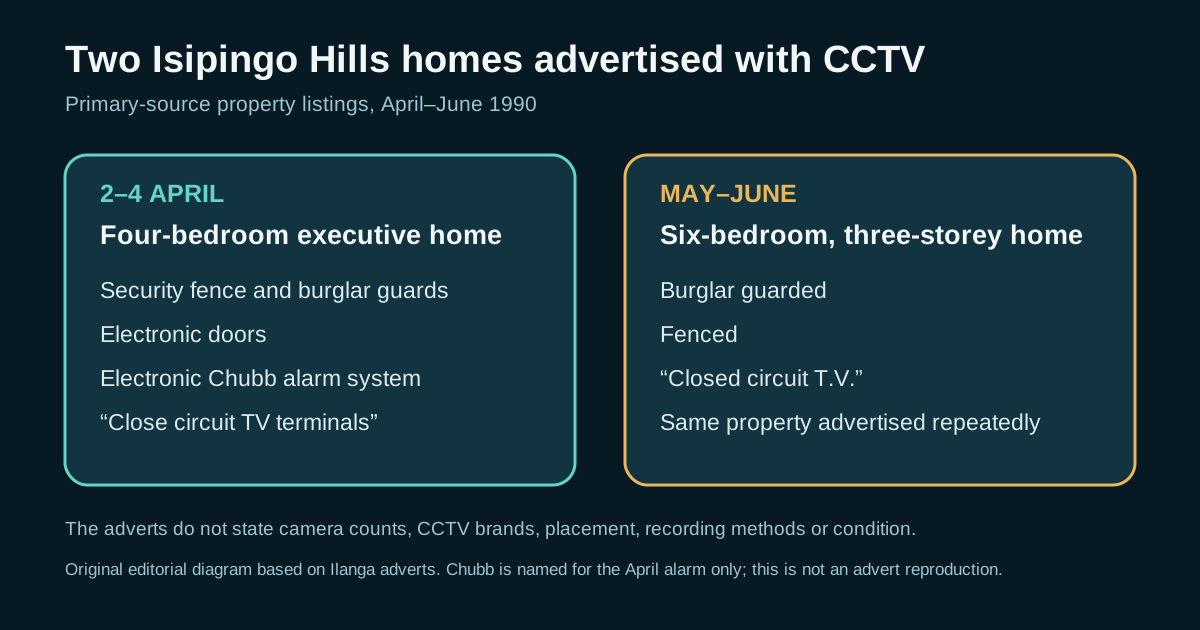
The evidence is unusually specific for a classified advert, but its limits matter. These pages prove that sellers marketed CCTV with two particular properties. They do not establish the camera count, camera brand, placement, recorder, working condition or reason for either system.
The April executive-home advert
The 2–4 April listing offered a four-bedroom executive house in Isipingo Hills. Its security features included a security fence, burglar guards, electronic doors, an electronic Chubb alarm system and “close circuit TV terminals”.
“Close circuit” appears to be the printed wording, not merely an OCR mistake. The reference to terminals also does not tell us how many cameras or monitors existed. Chubb is named in relation to the alarm system; the advert does not identify the CCTV manufacturer.
A second home in May and June
A later advert described a six-bedroom, three-storey Isipingo Hills house as burglar-guarded, fenced and equipped with “closed circuit T.V.” The same property wording appeared again in a subsequent issue.
The different bedroom counts and descriptions show that the April and May–June adverts concern two distinct homes. Conversely, the repeated six-bedroom wording should not be counted as two installations. It is evidence that one property was marketed more than once.
Archive OCR rendered the later phrase imperfectly in at least one record. We checked the visible scans rather than accepting the extracted text alone. That matters because damaged type and imperfect OCR can both hide genuine CCTV references and manufacture misleading keyword hits.
CCTV as part of layered residential security
Neither property presented cameras as a complete security plan. The adverts placed CCTV alongside physical barriers and detection or access measures:
- burglar guards reinforced openings;
- fences defined and delayed access;
- alarms detected an event;
- electronic doors or gates controlled entry; and
- CCTV provided observation or verification.
That layered logic remains relevant to Durban homes. A camera cannot replace a sound gate or protected window, while a barrier cannot create a visual incident record. Current systems also need to account for coastal corrosion, wind-driven rain, glare, night lighting, cable routes and backup power.
What these adverts change in Durban’s CCTV timeline
One isolated listing might be dismissed as an unusual luxury feature. Two different homes advertised within weeks of one another provide firmer evidence that residential CCTV was a recognisable selling point in Durban South by 1990.
They still cannot show how common home CCTV was across Durban or KZN. Classified advertising is selective, and both properties appear to have been at the upper end of the market. The safe historical conclusion is narrower: residential CCTV existed in the local property vocabulary, and sellers expected prospective buyers to understand its value.
This creates a distinct strand in Durban’s security history—alongside CCTV in Natal teacher-training research in the 1970s, commercial security marketing in the 1980s and municipal public-space systems in the late 1990s.
Research note
Sources: Ilanga, 2–4 April 1990, page 13; 7–9 May 1990, page 8; and 31 May–2 June 1990, page 12. We treat the adverts as proof of advertised features, not independently verified installations.