By 1990, security in greater Durban property advertising was no longer confined to a vague promise that an area was safe. It appeared in the list of things a house physically had: burglar guards, alarms, gates, fencing, electronic security systems and, in two unusual Isipingo Hills listings, closed-circuit television.
That does not tell us how many homes had security systems. It tells us something more precise and historically useful: sellers believed security features helped market a property.
The evidence comes from primary newspaper pages in Ilanga. Because the scans are copyright-restricted, we do not reproduce them. We also resist turning a small archive sample into a citywide statistic. The value lies in the language and the pattern across time.
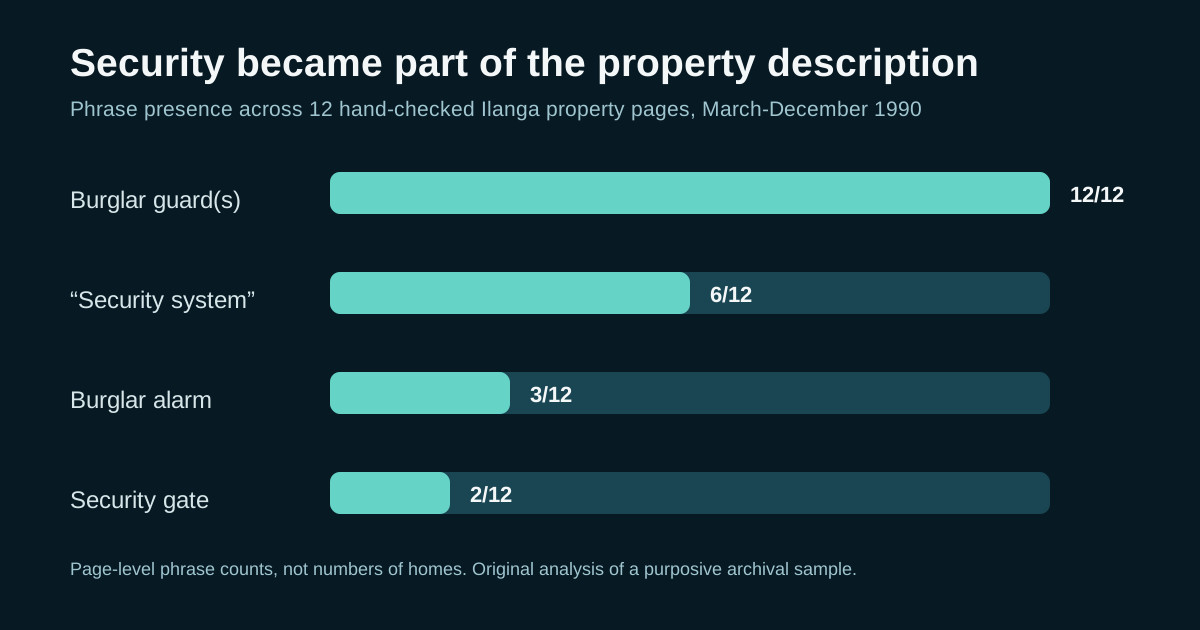
Page-level phrase presence in a purposive sample—not numbers of homes or installations.
A 1983 KwaMashu precursor
The earliest domestic precursor in the current sample is a property advert from 27–29 October 1983. A KwaMashu house was advertised with concrete fencing and an electronic burglar alarm installed on the premises.
It is one advert for one property. It cannot establish prevalence, effectiveness or a general 1983 trend. It does show that an electronic alarm was specific enough to be named as an installed feature, alongside the physical boundary.
That combination—barrier plus electronic warning—is the layered model into which residential CCTV later fitted. Cameras did not replace walls, guards, gates or alarms. They became another layer with a different purpose: seeing and recording.
What the 1990 sample actually contains
Researchers searched the 1990 Ilanga index for burglar guards, burglar alarms, security systems and security gates, then checked twelve relevant property pages spanning March to December.
Across those pages:
- all twelve contained “burglar guard” or a grammatical variant;
- three contained “burglar alarm”;
- six contained “security system” somewhere on the page; and
- two contained “security gate.”
Those are page-level phrase counts. A newspaper property page can contain many unrelated listings, and the same property can be advertised repeatedly. They are not twelve houses, adoption rates or installation counts.
What the pages do establish is recurrence. Security language appeared through the year and across listings in areas including Umlazi, KwaMashu, Klaarwater and Isipingo. It sat among ordinary saleable features such as bedrooms, garages, carpets, lawns and fencing.
Burglar guards became ordinary property language
Burglar guards were the most consistent term in the sample. Their repetition is important precisely because it is not technologically dramatic.
Physical bars and guards are passive. They need no power, network, app or operator. Their place in property advertising shows buyers were expected to evaluate the security layer of a home much as they evaluated parking or boundary treatment.
That expectation helps explain later residential CCTV demand. Once security is a normal part of the property’s feature set, adding electronic layers becomes a question of capability and affordability rather than an entirely new category.
“Security system” meant more than one device
Several pages used the broader phrase “security system.” The archived wording does not always identify the components. We should not backfill a modern meaning and assume cameras, app alerts or armed response.
The phrase itself is evidence of integration language. A seller could present security as a system rather than a single gate or set of bars. A September 1990 executive-home advert went further, naming electronic security systems and remote-controlled gates among the property’s features.
Remote control matters in this history because it links security to convenience. The gate is both an access-control device and part of daily arrival. Modern camera systems continue that blend: a homeowner wants evidence and deterrence, but also wants to answer the gate from a phone without fighting the app.
Two Isipingo Hills homes advertised CCTV
The most direct CCTV evidence comes from two distinct executive-home adverts.
On 2–4 April 1990, an Isipingo Hills listing described a four-bedroom property with security fencing, burglar guards, an electronic Chubb alarm and “close circuit TV terminals.” Chubb is named for the alarm; the advert does not establish the CCTV brand.
Separate May–June pages advertised a different six-bedroom Isipingo Hills house with burglar guards, fencing and closed-circuit TV. That second property appeared more than once. Repetition is repeated marketing of one house, not multiple CCTV installations.
The word “terminals” raises interesting questions but answers none of them. It could refer to viewing points or installed equipment language of the period. The advert does not state camera count, monitor count, layout, recording method, working condition or purpose. We should preserve the unusual evidence without inventing the system behind it.
Why CCTV appeared in executive-home adverts first
The archive cannot prove that executive homes adopted CCTV first. It does show the direct residential CCTV references in higher-end Isipingo Hills marketing.
That placement is economically plausible: early residential video equipment, monitors, cabling and installation were more specialised than guards or alarms. But plausibility is not evidence of a general adoption curve. The safe conclusion is narrower: by 1990, at least two separate Durban-area properties were being marketed with CCTV as a named feature.
Advertising is evidence—with strict limits
A property advert records a claim intended to sell. It does not independently verify:
- that every listed device existed;
- that it worked on viewing day;
- that it was well designed;
- that it recorded usable evidence;
- who installed it; or
- how representative the property was.
The pages are therefore excellent evidence for language and market expectations, but weak evidence for engineering performance or prevalence.
This distinction keeps the history honest. We can say security was repeatedly marketed. We cannot say most Durban homes had alarms, or that CCTV was common.
What changed between 1983 and 1990
The small evidence trail moves through three stages:
- a single installed electronic alarm named in a 1983 KwaMashu listing;
- repeated 1990 property language combining physical and electronic security;
- direct CCTV references in two Isipingo Hills homes.
At the same time, supplier advertising and recruitment from 1984 had already grouped alarms, CCTV, intercoms, automatic garage doors and gate openers for homes and businesses. By 1990, related language had crossed into property marketing.
The modern Durban lesson
Security remains a property feature, but a modern buyer should ask more than whether cameras are present:
- Who owns the recorder and app account?
- Is every camera recording?
- How many days are retained?
- Can footage be exported?
- Does backup power protect the whole recording path?
- Are views appropriate and privacy settings documented?
- Will the installer support the inherited system?
A 1990 advert could sell the phrase “closed-circuit TV.” A modern handover should prove what the system actually does.
That is the value of this archival story. It places residential CCTV inside a longer Durban history of layered security—and reminds us that a listed feature has never been the same thing as a verified result.