In its draft 2019/20 annual report, eThekwini identified the lack of an integrated city CCTV system as a challenge and reported commissioning an intelligent private video cloud with redundancy to create one platform.
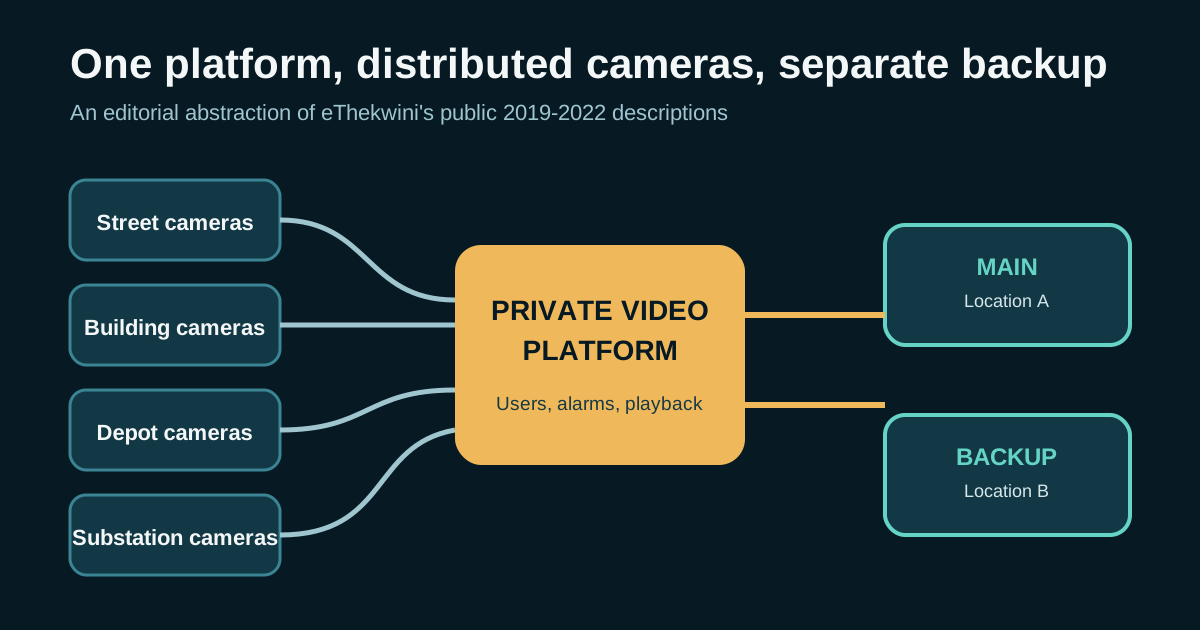
A 2022 municipal maintenance tender adds architectural detail. It describes street, building, depot and substation cameras, equipment from different manufacturers, several control rooms and a municipal video cloud whose main and backup components were installed at different locations.
“Cloud” did not necessarily mean public internet storage
The records call it a private video cloud owned by the municipality. Here, cloud describes a shared video platform serving distributed systems. It does not automatically mean a consumer subscription storing clips on a public provider’s servers.
That distinction matters when Durban clients compare products. “Cloud CCTV” can refer to several architectures:
- event clips stored by a consumer service;
- remote access to an on-site recorder;
- a hosted video-management platform;
- or a private shared platform spanning sites and control rooms.
The security, bandwidth and retention implications differ greatly.
Why integration was necessary
A large organisation can inherit separate recorders, manufacturers and control rooms over many years. Without integration, an authorised operator may need different applications and credentials for each area. Incident review becomes slow, and health information remains fragmented.
A common platform can help standardise:
- camera discovery and naming;
- user roles;
- live and playback workflows;
- alarms and health monitoring;
- evidence export; and
- maintenance visibility.
Integration does not mean every user should see every camera. Central management should make least-privilege access easier to enforce while preserving boundaries.
Redundancy requires a specific design
The tender states that main and backup components were located at different places for business-continuity and security reasons. Physical separation reduces the chance that one local incident disables both copies of a critical service.
Real redundancy also requires testing. A backup platform that never receives current configuration, cannot assume the workload or depends on the same failed link is only a second box.
For a smaller KZN organisation, appropriate resilience may be simpler: recorder UPS support, duplicate critical network paths, protected configuration backups and a documented replacement process.
The modern system lesson
Durban’s video-cloud history shows how CCTV changes with scale. Cameras become distributed data sources. The difficult questions move toward identity, permissions, bandwidth, storage, failover and ongoing health.
Research note
Sources: eThekwini draft Annual Report 2019/20 and CCTV/video-cloud maintenance tender 1C-3033. The accompanying diagram is an original abstraction based on those public descriptions and does not disclose or reproduce the municipality’s actual network topology.