The eThekwini Municipality’s draft 2019/20 annual report recorded conversion of cameras from old analogue technology to digital IP technology at 50 sites.
That one line describes a much larger coordination problem. Fifty sites can contain different power arrangements, cable conditions, camera purposes, control-room routes and maintenance histories. A migration programme succeeds only when those differences are documented and controlled.
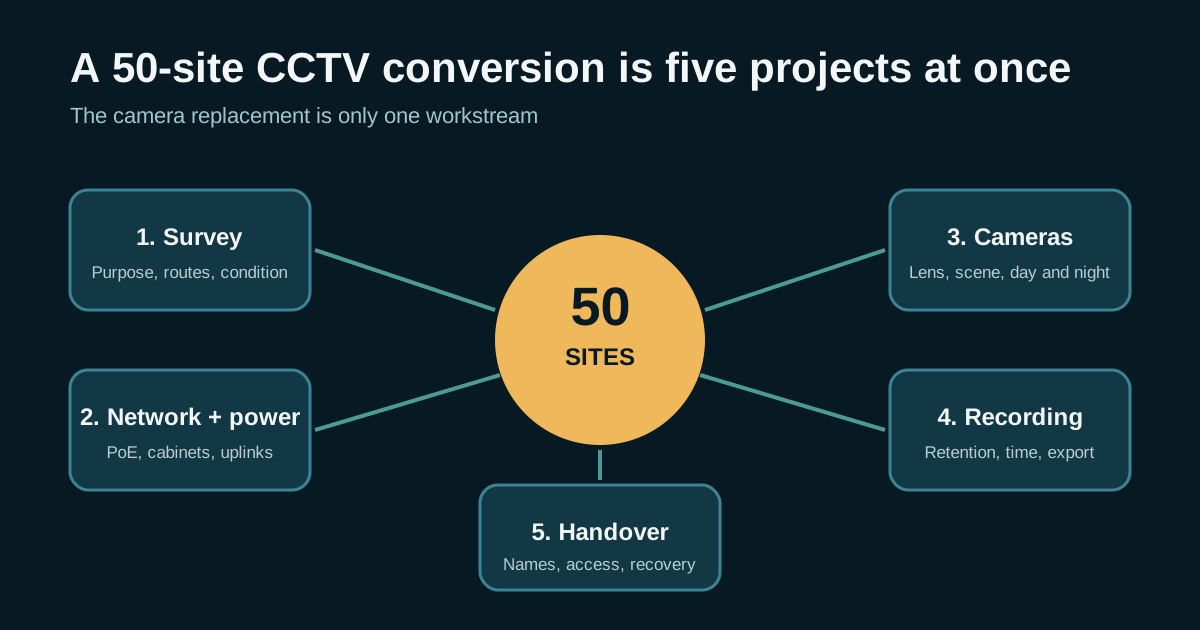
A site survey has to come before the replacement list
The first step is not choosing a new camera model. It is establishing what exists:
- which cameras are present and working;
- what each view is meant to show;
- cable type and route condition;
- local power and cabinet condition;
- recorder, monitor and control-room dependencies;
- available network and fibre capacity; and
- evidence-retention requirements.
Without a reliable inventory, the programme cannot distinguish a camera replacement from a network, power or recording problem.
Digital IP changes the infrastructure
An analogue camera commonly sends video over coaxial cable to a recorder. An IP camera becomes a network device. It needs an address, credentials, switch port and power budget. Its video consumes bandwidth and storage according to resolution, frame rate, codec, scene movement and retention rules.
Across 50 sites, seemingly small assumptions multiply. A switch that is four watts short per port or an uplink that is adequate during testing can create instability when every stream is active.
The cutover must preserve operations
Multi-site security cannot simply disappear while equipment is replaced. A programme needs a sequence:
- survey and document;
- prepare network, cabinets and storage;
- migrate priority views;
- test live and recorded performance;
- maintain access to required historical footage; and
- hand over names, permissions and recovery procedures.
Some locations may use temporary overlap between old and new recording. Others may require work during a planned service window.
Why a common standard helps
A citywide programme benefits from consistent camera naming, time synchronisation, credential ownership, firmware policy, export procedure and fault records. Consistency reduces the amount of local knowledge needed to support each site.
The same idea applies to a Durban business with several branches. A six-camera shop and a large depot may use different hardware, but their documentation can follow one standard.
Research note
Source: eThekwini Municipality draft Annual Report 2019/20, page 264 in the extracted report. The article treats the 50-site conversion as a reported programme item and does not claim completion beyond the wording of the draft report. The diagram is an original editorial explanation, not a municipal project drawing.